
Month: August 2015
Furries are Everywhere
I was at the World’s Fair of Money gathering recently that took place at the Donald E. Stephens Convention Center in Rosemont, IL last week. Here was this gathering where hardcore dealers buying and selling the rare and the unusual, but the one topic that they couldn’t forget was us Furries. It seems a good portion of those who visit this gathering by the American Numismatic Assn. were furries. I found that out when I talked to the reps for the ANA, They even mentioned they saw ears and tails, I wonder what would happen if fursuiters showed up one day. I even suggested that they set up a table there, funny thing they were considering it. Way to go coin collecting furs!!!
Califur 2015 }{}{ Savage Garden- The animal song }{}{
Mortality by JM
As originally posted on adjectivespecies.com
Death is important to us. When a furry dies, we—as a group—react strongly.
Following the death of a furry, there is often an outpouring of grief. Much of that grief is from furries who have never met the deceased.
Here’s the first comment on Flayrah’s news post about the death of Lemonade Coyote (link), a well-regarded but not especially well-known American furry:
I don’t know the guy, but I’m sorry this happened and I’m sorry for his family.
This comment is typical of the sentiment expressed by many furries in this sort of situation. It’s heartfelt, it’s sweet, and it’s clear that the commenter has been personally affected by the death of a stranger. The only thing that our commenter and Lemonade Coyote have in common is that they are both furries.
It’s unlikely that our commenter would be similarly affected by the death of a non-furry. This is not to say he would be cold-hearted, just that he is less likely to be personally affected by the death of, say, a fellow college student (that he had also never met). As has been discussed in [a][s] in the past by Makyo (Death in the Fandom), there is something about the interconnectedness of our furry community that makes death affect so many of us so greatly.
I think that there are a couple of reasons why death is so important to us as a group.
For starters, furries are young: about 90% of us are younger than 30 (ref). And like any group of young people, furries are more inclined to spend time with peers rather than the wider community.
We live in a world where our social choices, at least outside of high school, are dominated by urbanization and the internet. We are able to socially discriminate more than at any other time in human history: we can choose to hang around with people of similar interests, similar culture, similar socio-economic background, and similar age. Most of us are not required to participate in a community dictated by proximity, such as in a 1600s village, or a tribe.
This shift in the way that humans form social groups began with the Industrial Revolution, just 200 years ago (the blink of an eyelid in evolutionary terms). It is the cause of significant challenges for many people in today’s world. We share our living space with an overwhelming number of people. Because we can only manage a limited number of social connections, we must be choosy. This process of exclusion makes it easy for someone to feel lonely despite being surrounded by people, or to be rejected from a social clique.
I’ve written previously about how society can be alienating (Furry as an Alternative to Religion). I believe that furry provides a rare social environment that is based on inclusion. It’s one of the great things about furry: everyone is welcome by default. Our culture is more in tune with the idea of community as a whole, compared to the wider world.
Our close community means that we may be personally saddened by the death of another furry, even a stranger. We have lost one of our own, and we know that the death will be felt keenly by other furries.
It doesn’t help that furry deaths tend to be sudden. This is due to our demographics: largely young, and largely male.
The leading causes of death among young men in the United States (ref) are (1) Misadventure (or ‘unintentional injuries’, perhaps from a car accident) and (2) Suicide. This is how furries die too.
Death through misadventure and death through suicide are relatable for most of us. We may have done something stupid, or otherwise been in a situation that placed ourselves at risk. And all of us—yes, all of us—have had suicidal thoughts. We can personally relate to these causes of death, and it’s natural for us to fantasize about them.
When we fantasize, when we fixate on death, we are experiencing a mortality crisis. We fantasize about how the moments before death must have felt, we fantasize about last thoughts, we imagine how we might have acted in the same situation. We find death (when it’s relatable but not so close that we’re overcome by grief) to be engaging.
We sometimes feel bad for being engaged by death. We read through last comments on FA, or Twitter, or Livejournal, and try to picture the subsequent events. And then, sometimes, we feel remorseful, as if our reaction were disrespectful. But our reaction—the mortality crisis—is normal, and normally positive.
In the non-furry world, the death of a celebrity can cause a similar outpouring of grief. Despite the celebrity being a stranger, many people feel compelled to express their personal reaction; perhaps in a comparable fashion to our commenter on Lemonade Coyote’s death, or perhaps in a more overt way. Such expressions of grief are sometimes pathologized: people assume that the griever imagines a personal connection with the celebrity. Such behaviour is sometimes compared to stalking.
FindAGrave is a website where people can leave comments, virtual flowers, and nauseating animated gifs by way of remembrance. As an example, the amazing screencap below is taken from James Gandolfini’s page:
In this case, it’s easy to assume that these commenters are delusional (along with many, many, many others on FindAGrave). But I don’t think that all those who feel a strong connection to Gandolfini are confused over whether there was a real relationship. It is simply that Gandolfini was well known, so it’s easy to fantasize about his death.
Gandolfini’s death provoked a minor mortality crisis in some people, just like the death of Lemonade Coyote did for some others. Public memorials like FindAGrave (or the comments sections on Flayrah) provide an avenue to express that feeling. Such comments are mostly about the writer, not the deceased.
It’s rare for us to think about the inevitability of our own death. Our innate ability to avoid thinking about death is probably an evolutionary trait. Life would simply be too stressful if we were to consider our own death when engaging in risky activities, like crossing the road. So on the rare occasions where death comes to mind, it can provoke a strong and unexpected reaction—a mortality crisis.
A friend of mine recently witnessed a pigeon’s death. He heard it crash into a second-story window, and watched as it twitched and died on the pavement below. It took around 15 minutes to die as my friend stood transfixed, unable to pull himself away from the grisly spectacle.
He told me that he felt ashamed by his compulsion to watch the pigeon’s death. He described feeling queasy and stimulated, almost excited. In hindsight, he judged those feelings as ‘wrong’, that he should have been less curious, or more respectful. But there is nothing wrong with his feelings. They are the same ones that provoke an emotional response when we read about the death of a furry, or seek out footage of fatal accidents on the internet, or watch clips of the September 11 attacks.
Oliver Burkeman, a British journalist who writes on mental wellbeing (here), argues that thinking about death is healthy. The prospect of death—that of our own or of a loved one—puts the value of life into relief, and can remind us of those things we find valuable. Burkeman suggests that we should take time to consider the inevitability of death. It’s a kind of small, planned, pre-emptive mortality crisis.
I agree that this is a healthy way of managing the spectre of death, and we can learn to live life in a more enjoyable fashion if we are able to consciously acknowledge mortality.
From a linguistic point of view, I think that the term ‘bucket list’ is aesthetically ugly. It’s a clumsy reappropriation of an anachronistic metaphor, ‘kicking the bucket’. But from a philosophical standpoint, a ‘bucket list’ is a good example of Burkeman’s principle in action. We have a limited time on Earth, and the thought processes involved in compiling a personal wishlist can help us broaden our horizons. As always, we make ourselves happy through personal improvement: physical, mental, spiritual.
Furry offers great opportunities: opportunities for travel, for personal relationships, for new experiences. A furry ‘bucket list’ might include a visit to a large convention, or a trip around the world to meet a close friend. Such goals are rarely easy, but they are often achievable for someone who is motivated. Consideration of death can add purpose to life.
This article released under a Creative Commons BY-NC-SA 3.0 license
The Last Califur (Califur XI 2015 Irvine)
Califur 2015 W/Candy Box, Disco, and Kululu987
“The Real Me” — Megaplex 2015 Music Video
Gluten Free (w/ Gluten Booty Dance) (HD) : Foamy The Squirrel
Califur 2015
Business Card for This Very Blog
This year I decided on doing something a little different, and that is promote this blog, so I hired a local artist do this for me…
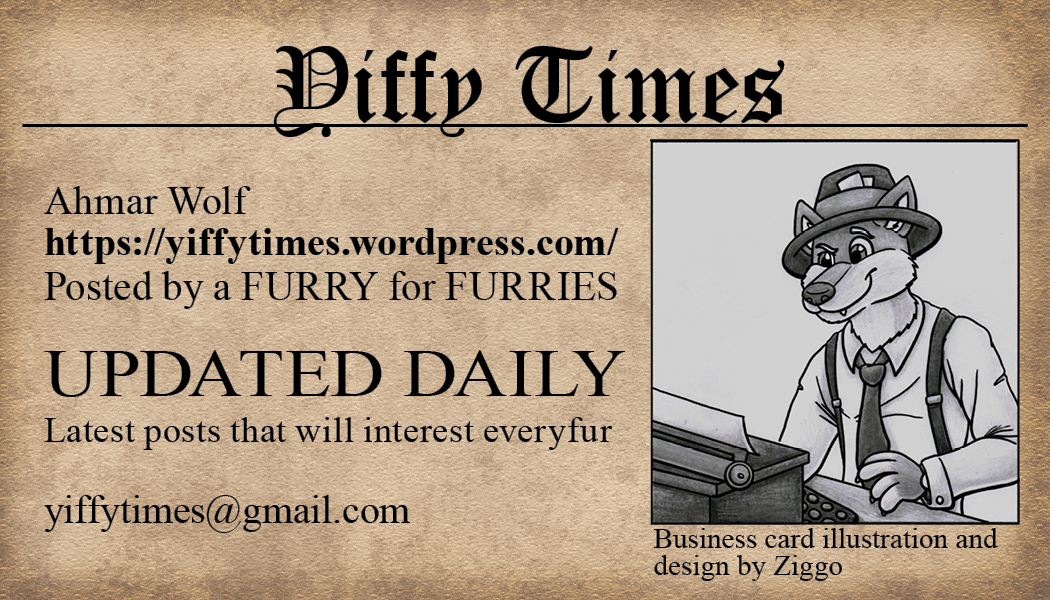
Her name is Ziggo, check out her FA page.
I will be handing out at the local fur events, and of course MFF. If anyone wants one just check out the Contact Me tab and drop me a message, and I see you get one. Or just leave a comment below with your email address and I will get back to you.
 Furry Times