Review: ‘Splice: Conditioning’, by Cocoa

by Huskyteer (Alice Dryden) as originally posted on flayrah.com

This review is part of my commitment to reviewing anthropomorphic literature during Furry Book Month.

Described as a ‘dystopian sci-fi erotic novel’, Splice: Conditioning is set in a near future where natural disasters have made large parts of the USA uninhabitable and plunged many of its citizens into poverty.

One light in the darkness is the presence of Splices: genetically engineered, anthropomorphic dogs who act as companions and sex toys, as well as taking over some of the riskier or more unpleasant jobs.

Because of the dangers inherent in creating human-sized dogs capable of rational thought and tool operation, each Splice has a Conditioning Phrase known to its creators and owner, and is programmed to enter a submissive, obedient state when this is spoken.

Self-published, 2016, ebook $2.97.

Lexi, who works as a waitress in the depressing surrounds of Fort Miami, loves her St Bernard Splice, Henry, won in the state lottery. Mikey, electronics whiz-kid and club DJ, loves his German Shepherd Splice, Kaleb, the bodyguard assigned him by his Russian managers.

And yes, they both ‘love’ their Splices in that way, too.

Let me be clear: there is a lot of sex in this book. There’s sex in every chapter, and there is sex for whatever combination of male/female, sub/dom, dog/human that floats your boat, with a couple of bonus fetishes thrown in.

Although frequent and varied, it never feels out of place. The sex scenes serve to give us a deeper understanding of the characters, and they help drive the story along. Unlike some erotic novels, there’s a satisfying amount of story to drive.

Lexi and Henry save enough to buy a plot of cheap land, with the dream of turning it into a farm and living off the grid. Their advertisement for extra help is answered by Mikey and Kaleb, who are on the run from the Mafia, and another Splice, Andrea, joins them as housekeeper.

So far, so idyllic. But there’s more to Splice than sexy fun on the farm: the characters find themselves in possession of a dangerous secret that might affect the future of Splices, freeing them from their Conditioning and, in effect, their slavery. Inevitably, opposing forces would rather they didn’t investigate further, and discourage curiosity with violence.

The group sometimes seems to solve problems too easily, with Mikey in particular overplaying his computer-genius card, but there was enough suspense and mystery to keep me reading.

The world of Splice: Conditioning offers much more than a contrived setup for lots of human/dog sex. It’s a rich landscape with potential for further adventures, and I hope we’ll see some.

You can read sample chapters and side stories at Cocoa’s SoFurry account.

Corpus Lupus Review by Greyflank

30300363

This book is actually a collection of three novellas about your worst nightmare: A WEREWOLF WITH A BADGE.

OK, I know for some of you (me included), the image that first comes to mind might be more erotic than horrific… but I assure you that your ride along is going to take you into some deeply, darkly, disturbing places.

Highridge is a cop that became a werewolf in an Urban Fantasy Setting where lycanthropes have a subculture and are an accepted part of modern society. And the revelation of their existence is no recent thing.

As is often the case when the werewolves are (mostly) good guys, there are worse things out there than wolfmen.

Legion Printing and Publishing, 2010, ebook $2.66 (194 pages).

Readers, do you have triggers? You will find them here. All that you think is right and wrong in the world has little to no relevance here. God isn’t dead; but he wishes he were. If Horror Noir is a thing…this is a collection of Horror Noir.

In point of fact, almost all the magical power in this world comes from death of some sort. Demons are but a thin membrane of reality away and necromancers are the first line of defense against these threats and many the public never ever hears about.

Every corpse is staked, for example. Bad things could happen when a corpse isn’t staked.

Corpus Lupus
Killing a child in a universe like this creates a lot of energy the killer can use for almost any purpose, provided he knows the best cuts. The butchering of three boys in the shadow of their tree house provided the murderer with a lot of power.

The race is on, not just to “bring the killer to justice,” but to keep him from using that power to do… well, anything he wants.

The crime and the risk is enough for the necromancers to send in Dr. Muggs, the local necromancer and fixer. It is an awkward teaming as there is so little Muggs can tell Hightower without violating his oath of secrecy.

Things aren’t made better with Hightower’s Alpha getting on his case and trying to provoke a battle between them. Cop ethics and Pack ethics do not align well. Before the case of the child killer can be solved, Hightower is too driven by instinct to be a good cop. He takes medical leave.

The story provides good procedural and easily doles out the magical rules (which stay consistent through all three novellas). Hightower seems like a good man and an honest cop, and, in the end, he must sacrifice a little of his soul to save his life and bring a killer to justice.

Pit Wolf
The story starts out with the same police procedural trappings as Corpus Lupus but it quickly veers into outright horror as Hightower attempts to investigate an otherworldly portal. As established in the previous tale, murder is the most powerful force there is. Hightower knows death is on the other side of that door. Yet…yet…a whole apartment is missing. And the family that lived there…one or more of them might still be alive.

Now, the rescuer must be rescued from the nicely written plot of hell that apartment has become.

There is a gate-keeping monster here, too, drawn from the mind of Hightower himself. A bigger, badder wolf that Hightower must escape and, if he survives, destroy.

It’s a tense and exciting series of events where Hightower’s own werewolf instincts might betray him and the solution to this is interesting and a little mind-warping. My only complaint is the big bad is referred to as bisexual when the description obviously shows the creature to be more of a simultaneous (or synchronous) hermaphrodite.

And a rather vigorous one at that.

Now, I know (I cheated and looked it up) “bisexual’s” original meaning is exactly that: “having both sexes in one being, hermaphroditic.” Still, in a modern setting it’s rather upsetting to see one’s label used so monstrously.

I’m sure that I’ve done worse, so enough on that.

There’s some magic in a conference room that I think I could have done without, especially knowing that someone died for that Power for that trick, in whole or in part. Yet, when I reflect now, I see that this mild scene, as mundane as making flowers out of thin air could be compared to the hellish summoning and werewolves tearing out each other throats… it does hint at the shades of humanity that Hightower has already lost.

You see, in the first story, the werewolf detective knows the names of the victims who donated their ashes. He is acutely aware of each sacrifice as much as he is able. He is fascinated and not appalled by his lesson… or its cost. I am curious to now if that’s how Smith intended it.

Loop Garou
A small departure as Hightower travels with his pet monster, but he very quickly ends up investigating a magic murder. Although there is a great deal of debate about the nature of the killing.

We discover much more about the nature of magic and of the multiverse that this universe is a part of. Hightower has to face aliens and, worse, what people must do in order to survive. Plus he meets what may be the mad god at the center of it all.

This last story had a few light and disturbing moments and presented a more rounded story than the other two. It is also infinitely darker as Hightower once more allows himself to become a tool for the greater good in a secret war of sorts.

It is a darkly refreshing universe that reminds us Power has a cost.

as originally posted on flayrah.com

This article released under a Creative Commons BY-NC-SA 3.0 license

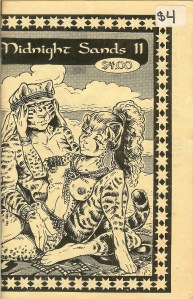
Midnight Sands #2 Review and Download

ms2-0001

You might be asking yourself what exactly is Midnight Sands #2? It’s arabian nights theme furry porn. Although the art tends to be more human than animal. Is entertaining and very interesting to see what these 16 artists did back in 1993.

Midnight Sands #2 contains work by Chris Morrissey, Brian Sutton, Michael Hirtes, Mitchell Beiro, Ted Shepherd, Dennis Clark, Steve Martin, Kurt Wilcken, Maggie De Alarcon, Charles Davies, Reed Waller, Daphne Lage, Todd Sutherland, Alan Nepocemo, Scott Alston, Jeremy Kidd, Dan Flahive

Midnight Sands #2 and be both viewed and downloaded here

Ulster comic review

ulster-issue-1-48983

Frankly I would not even of heard about Ulster if I wasn’t so passionate about older furry stuff, and the pedigree on this comic is very unique. Published in 2009 by Dream Field Comics (Who was about to close down operations in 2010) who are frankly better known for Softpaw Magazine. But Ulster is so unique, the artwork is dark and very stark. I want everyone to understand this is clean comic and definitely has no cub. Once you look at the art by T.D. Ward who also wrote it. You will absolutely wonder why you never heard of them. Each page is a work of art reminiscent of Gory. The world is harsh while the characters are soft. Could be an allegory to life itself. This was to be the first issue in the series, too bad we never got a second issue.

The story of Ulster is simple, it’s about a jackalope named Ulster who leaves his forest doomed by man to help his fellow animals. It is when he run into these 2 foxes that we discover life is a fragile thing. It really doesn’t end happily but Tori D. Ward, made it that way because life is very fragile. Only consisting of 30 pages the author make that point quite clear where in the end where we see the forest he tried to save completely destroyed.

Frankly this was nothing like what I expected, I figured I would get a standard furry comic. Not a statement on life that you want to look at it again and again.

If you like both a story and artwork that is very unique search out Ulster from Rabbit Valley. It costs on $5 and worth more than double that price. I will even go on record as saying possibly triple.

Trouble 2 Now available in Downloads

Trouble 2-0001

Trouble Issue 2 is more a curiosity than anything else. It’s comics are more a collection of interesting stories that has been turned into comics.

These being My Uncle Nick which tells what happens to a young man and his eventually journey to america. Well worth a look.

The Legacy, more how the shadow of Hitler still hangs over Germany though those who survived WW2. Very compelling.

The last is A Hairy Affair, which tells a tale of 2 guys from Universal Urine Testing and their effort to make all it’s employees go bald and loose their body hair. Funny and deserve a look.

In addition there is 5 art pieces and only 2 use anthropomorphic animals. These creatures do no appear in the comics. The better of the 2 is the take on the very old Klondike ice cream bar ad. With Bastet the cat god of ancient Egypt, who was also their god or war. Very funny.

Over all I say it is worth checking out. HERE

New Fur Science! E-Book

by Makyo as originally posted on adjectivespecies.com

You know how much we love data. If data were a person (with apologies to Brent Spiner), we’d have a total crush on them. We really like data.

So it is that we’re basically ecstatic to see the release of the Fur Science! e-book.

FurScience.com is the home for our wonderful friends over at the International Anthropomorphic Research Project, who has contributed to this site in several ways through the guise of Nuka/Courtney Plante. The IARP does several studies through the internet and through conventions – and these are scientific studies, unlike our Furry Survey, which is primarily a market survey – and through the data that they have gathered, they’ve pulled together a fantastic resource for furries and non-furries alike.

Furscience-Furbook-First-5-768x238

The Fur Science! e-book is a fascinating deep dive into several of the studies that the IARP has done, ranging from demographics to therians and bronies, and everything in between. If you like data just as much as we do, you’ll certainly enjoy paging through the 174 pages of graphs, charts, and explanations. Hats off to Nuka and crew over at the IARP for pulling something like this together.

You can download the e-book for free as a PDF here, and check out the rest of IARPs information and offerings on their webpage.

This article released under a Creative Commons BY-NC-SA 3.0 license

Review: ‘An Anthropomorphic Century’, edited by Fred Patten

AnAnthropomorphicCenturyFront420

By Greyflank

Edited by Furry Fandom’s most beloved Eagle, Fred Patten, An Anthropomorphic Century reprints stories ranging from 1909 to 2008, including the talents of Peter S. Beagle, Philip K. Dick, Michael H. Payne, Phil Geusz, Renee Carter Hall, and more… including myself.

Starting with “Tobermory” by Saki in 1909, Fred does an excellent job putting these stories in a historical and social context. Around the midpoint, however, the historical context begins to soften just a little. The stories are excellent, but not all are milestones, so I would have enjoyed a bit more perspective in what was going on in the real world when they saw print.

Fred may have decided to let the newer stories stand on their own rather than distracting readers from the work themselves. Perhaps this was a good decision; the collection puts on no airs that of a textbook, after all – but Fred Patten is an expert historian of two fandoms (the other being anime). I couldn’t imagine a person better suited to bringing external context to these stories.

Disclaimer: I have a story in this anthology. I’ll address that story last.

“Tobermory” by Saki
Saki, aka H.H. Munroe, was a wry social commentator in the UK of the early 20th Century and the cat, with it obvious and unmistakable disdain for humanity yet its seemingly cultured behavior makes for the perfect mirror for the cultured set.

It might not be considered Furry by fandom’s standard, and the science may be weak, but it is most certainly an anthropomorphic work, allowing a cat to speak to its “betters” and finding the “betters” wanting. The nearly unanimous plot against Tobermory for his mere honesty says enough about the upper class to get Saki’s point across.

I found it amusing, although I had to reread a few sentences several times. I suspect I missed some humor simply because some references were now too obscure for me to understand. More of Saki’s stories can be found here with no annoying pop-up ads.

“Dr. Lu-mie” by Clifton B. Kruse
Amazing Stories was a pulp magazine with the thinly veiled intentions of teaching science through, well, amazing stories. This kidnapped horror piece was meant to educate young minds about termites in 1934. The most amazing thing to me is that this isn’t a story about how to kill and destroy the damn things.

The victim or hero of this piece is rather randomly invited into Dr. Lu-mie’s lair, although that might be because the tall, talking bug only knew what the local natives could teach him?

I’m not too fond of educational science fiction, but talking bugs are rare outside of truly demonic horror (at least, in my experience). I give it 6 out 10 stars and it only gets a six because it does show the evolution of anthropomorphic.

“The Blue Giraffe” by L. Sprague de Camp
A very enjoyable tale with the kind of framing sequence that I just adore, the conversational doughnut. In this tale, the conversation is an child asking his father if he was adopted. Apparently the child, Peter, is different enough from his father and mother that they can’t be related. De Camp wisely decides to skip describing the child.

The story is one of fantastic mutations and a people who just so happen to look like baboons… except, as it turns out, they are mutated baboons. He rescues one of them, they rescue him. It’s a classic “adventure” shtick we’ve seen before that suddenly forces an unwanted engagement on the civilized man.

Except the Baboons want to breed up the evolutionary ladder.

I like this story, even if the father seems to chicken out from admitting that the boy has more monkey in his mix than other “guys” he hangs with. Well, who knows maybe he is being honest or everything is a lie and he told his child to completely distract him.

Fred notes that in the 80’s on forward, the furry fandom always had fuzzy animal mutations breed true. I don’t think that’s quite true. Metamor Keep’s cursed Keepers had normal human babies… except when two exact cursed species mated.

I had unpublished stories in the ’90’s from a world I called “Story World.” A few humans were born every year to Furries that otherwise bred true. These humans were universal breeders; but I don’t think I created more than three or four stories, and my storyverse name kinda tells the much older me that maybe that was a good thing to stop there.

I enjoyed this story with primitive and not idealized Baboon Furries, and I’m old enough to wonder how much truth is in the story within the story.

“Barney” by Will Stanton
This is a short and wonderful lab rat story. Seriously amusing,
I give it four our of five lab rats. Females. Not Males.

“Expendable” by Philip K. Dick
Enough people have claimed that Dick was extremely paranoid that it now qualifies as a world-wide conspiracy against him. Still, the paranoia brings a wonderfully unique flavor to his oft imitated work.

Imagine Dr. Doolittle gone horribly wrong. Well, not the man so much, as the universe about him.

Of course, the universe has a thing or two to say about that. Man is an invader to Earth and the insects are working in secret to eliminate humans. This one man, who can suddenly and accidentally understand all bugs, cannot be allowed to destroy their plans.

It’s a charmingly paranoid story with a neat but unhappy ending. Perfectly Furry, even if we don’t see many mammals. The black widow is kinda fuzzy, so that should count for something.

“The Conspirators” by James White
This story was a joy and very complex tale disguised as an escape-adventure story. Felix the cat (not that Felix the Cat™) plays strong man for a group of uplifted mice… and some silly hamsters.

Just before the escape is completed, Felix gains a complex and deep insight to not only to the fate of the mice and, by extension, his own future, but to humanity among the stars. This is one of the most brilliant furry SF short stories that I’ve read this year so far and its over 50 years old.

Hard SF to boot, especially the scenes without gravity.

“Sic Transit… ? A Shaggy Hairless-Dog Story” by Howard Waldrop
I love Willow and Patrox and I love the fairy tale feel of it all. Published in 1976, it’s not to jarring to have Willow wanting to be breed with something… anything… even if he gets brutally rebuffed for his efforts. No, no details in the book but Willow doesn’t realize that his battle is with Mother Nature… but Patrox finally shows him how to best survive her wrath.

Cute story. It’s very telling that this allegorical tale premiered in STELLAR 2, Science Fiction stories collected by Judith Del Rey. Fandom, Writers, and Publishers were all struggling to define what SF really was. In the mid-Seventies, SF was whatever the publisher said it was.

“Crow’s Curse” by Michael H. Payne
According to Fred, the Ottergate universe is the first Furry Fan series to contain professional quality stories. I can’t argue with the quality, but I wouldn’t envy the person who went back to read all the Boards and archived Geocities sites to be sure. (Plus, it predates my entry to the online Furry universe, so why argue? :-D)

I love the complexity, not just of the world, but of the characters and their turmoil. I read a lot of pieces from a few years before (and many years after). A great many Furry (and TF) writers are often too content to let impulses, wants, and needs overlap into a gray quagmire of unquestioned actions and pat justifications. It advances the plot.

The plot is merely a vehicle to a story.

This story’s a journey into temptation and beyond. Sure, it’s about guilt but there’s also world-building. Without trotting out a single human, it speaks elegantly about Humanity and society.

So far, it’s one of the most well-rounded tales in the book, giving a nod to fantastic story elements while still allowing an out to a “mundane” explanation of the science of the world. It’s also an allegorical tale (which Furry is so great at) of addiction and the shame that can come with “slipping.”

I would prefer this universe over the Red Wall universe, so now I need to add Payne’s “Blood Jaguar” to my reading list.

“Nine Lives To Live” by Sharyn McCrumb
Stray cats can turn up anywhere, like in this story with transformation via reincarnation. It’s not an uncommon ‘trope, so it doesn’t feel as fresh as it might. Still, just a bit above average.

Despite being a tale of murder and revenge, there is a lightness here that I like. Danby’s hand/paw is sorta forced to commit murder because his human murderer turns out to be a pretty decent cat daddy.

“Vole” by John Gregory Betancourt
Short, sweet and funny in a backhanded way. It certainly got me to want to read Rememory by John Gregory Betancourt. Now, if only I could find a non-Kindle version.

“Choice Cuts” by Edd Vick
I subscribed to Electric Velocipede in the early 21st century, so I got to read this in the “non-furry” version. It was and remains a very, very good story. Making it furry certainly adds more color and flavor, but it doesn’t really change the plot. In the “normal” version, I recall that I was quite happy with how the Farmers accepted Robin’s change. It was, as I recall, little more than a transgender change. It was the near future and I like that race changes weren’t that big a deal. That sex reassignment only produced a little bit of awkwardness.

In the furry version, these Unchanged Farmers are basically surrounded by monsters. Not that their colony couldn’t have some fancy genetic stuff compared to the modern day, but the refugees implied that their technology was more limited to detection and not correction. So, I wouldn’t think a talking squirrel would be so easy to accept. Hell, they maybe never seen a wild squirrel in their lives, except on whatever media they have up there.

I’d have like to see more of the farmers coming to terms with their surroundings and the new culture they were throwing themselves into. But that would have made it a different story, I suppose.

I love the term NullPop and the lack of curiosities explanation. It’s a good world. I wonder if Edd Vick has ever revisited it.

“Transmutational Transcontinental” by Phil Geusz
A wonderful and classic Transformation story for which the Rabbit has always been good with.

It’s short on action, but long on animals.

Note: The intro to this story implies otherwise, but the website that ran the contest this story won is still around, with the submitted stories: although the contests themselves were short lived.

“Daylight Fading” by Chris Hoekstra
My fondness for Metamor Keep runs very deep. I’ve been involved in this storyverse/shared universe for almost 20 years, on and off. But it has quirks, beyond the triad of shape-changing curses set upon the Keep and its defenders.

One of the hardest things for me to get used to was the modern attitudes and speech patterns of those supposedly in the medieval period. After watching A Knight’s Tale and a few translated movies I began to accept that they weren’t speaking in English, so I shouldn’t get hung up on that… and if the Keepers seem too sophisticated for a feudal society, than it was simply because they’d had to step up their game during the last seven years under this twisted curse.

If you don’t like Daylight Falling, the only good reason for that is that the dialogue and settings might be a bit jarring if you are looking for Ye Olde Phantasy setting. Or maybe not, the scope of fantasy novels have changed a bit since 2000.

It’s a slice of relationship life as the Kayla and Rick work to build bridges or take down walls… not an easy thing as they were both cursed. All the real work was pretty much played out in other stories. We are down to relationship basics… are we both ready to take the risk? And will we?

Is it Furry? Well, the plot’s not terribly furry. We could easily make it a story about two recovering drug addicts with very limited changes. Or any mix of scarred people. But there’s some very nice furry flavor text in here that is worth reading and enjoying and if you visit the website and read Rick’s stories in order, I think you’ll enjoy all this tenfold.

“The Dog Said Bow-Wow” by Michael Swanwick
Two con-men walk into post-Collapse London. One is a human. The other a bio-engineered canine. The titular dog, Surplus, has quite a tall tale that starts out with an SF feel that very quickly goes fantasy the second it all goes South.

In addition to a nice little matchstick plot, we also get a little philosophical insight into the price our creations pay for their roles. Rogues in a rich environment.

No wonder Surplus and Darger had other tales told.

“Cat ‘n’ Mouse” by Steven Millhauser
I started out thinking that I would hate this story. A cat and mouse chase scene or scenes in text? How is this going to be a fresh or exciting thing? I figured that it was just here to fill a historical slot.

Well, what does this horse know?

This was more than a bit surreal and yet the best cartoon setting in text that I have ever seen. Whimsically dark with action and deeply introspective, the Cat and Mouse story is about conflict and escalation. And the best and most unexpected parts are when we get inside the heads of our furry leads.

The end result is that all the cartoon violence we laughed out over the years become not funny but somewhat horrifying and we get to see the toll this takes on the long term combatants. And once you accept the horror, a dry, sadistic undertone of humor might be detected.

“Pig Paradise” by Scott Bradfield
This was a wonderful slow burner of a story that explores the emotional expanse of prejudice and working relationships. At first, my real sympathy was with Harry Wolf, who apparently really, really needs to be liked and get approval from those around him. I KNOW that feeling.

I didn’t feel much sympathy, at first, for Hubert Pig, who seems something of a bigot and easily annoyed. Yet… And yet, within a few pages I saw the burden Hubert’s anxiety is creating for the pig. I know those feelings, too. He can no more help his anxiety than Harry can suppress his need for approval.

And then these two are neighbors, so the poor pig doesn’t even get much relief at home.

Things escalate in a natural – and emotionally honest – fashion. These two are reacting and living under a political system on governmental, corporate, community, and family levels that are revealed with a very deft hand. Their wives and children with only a few lines are fleshed out nicely, and while they seem very wise in their support of the spouses and each other, they also commit a cruel deed that suggests there’s at least one shallow end of the pool.

But people are like that. People fall short everyday and then… well, life goes on.

The story builds up to the destruction of one of these men… and where the average Furry writer might end the story with that destruction, Scott Bradfield does not.

And it’s those last few pages that really made me realize the level of craft and art in this story, as well as the understanding of humanity and Urban society.

“Sergeant Chip” by Bradley Denton
There’s a whole sub-genre in Furry Fiction about Uplifts for military reasons and editor Fred Patten wisely packed this one to top and represent them all. This story won the 2005 Theodore Sturgeon Award and you don’t have to be in much more than a page in to seem the glimmer of why. Chip sounds like a military person and he sounds very much like a dog. When he comes to a concept he doesn’t understand, he accepts that. It’s either mission critical or it’s not… but he does it without a lot of buzzwords like “mission critical.”

What does a dog need with buzzwords?

I am not overly fond of the story delivery conceit of Chip mentally transcribing English dialogue for the English illiterate girl to write down, but it does work in the added benefit of showing that Chip has earned his stripes by becoming a leader; rather than a mere soldier.

I hear Fred is putting together a Dogs of War anthology. If this story is the bench mark, it’s going to be quite a collection.

“Gordon, the Self-Made Cat” by Peter S. Beagle
What a wonderful story about the power of challenging one’s self and challenging the assumptions of others!

A wonderful allegory doing what furry does best by a master storyteller.

The first draft was apparently written in the 40’s, but the idea of self-determination by sheer stubbornness and hard-work still seem as relevant today. Even more so to a group of Furries who believe you are exactly what you decide to be!

This story is so wonderful, I’m considering having children just so I can read it to them!

“The Wishing Tree” by Renee Carter Hall
We started this collection with a 100 year old science fiction story, one of the newest genres in prose, and we are ending with this wonderful allegorical animal fable, one of the oldest prose genres (prose historians may send angry and educational corrections… I’ll read them eventually).

There are so many things I could say about Hall’s writing. One of them being that I am jealous that I could never write such a pleasant tale. My impulses are too dark and mean and I cannot not master them – or at least, I have not yet.

And in this story, we see the unintended victims of alcoholism and mild neglect who deserve a better life. Under her keyboard, she is able to weave a sweet and funny tale that any of us could read to our children.

That’s a talent, and one I admire. And here’s my story…

“The Good Sport” by Bill Kieffer
I wrote this story in 2000 and it was nominated for the Ursa Major Award in 2001. One of the rules of Metamor Keep is that there are no conspiracies to overthrow the Duke. Well, I just had to see how far I could bend that rule with my Reavers.

While this introductory story isn’t about overthrowing anything, I think it’s a nice story about some boys playing in the woods… and one of the boys doesn’t understands the rule as well as he thinks…

This story introduces, I believe, the first cis-gender gay male Keeper who isn’t a rapist; Lars. While homosexuality is tolerated in Metamor Valley, it’s only because of the curse (TV Tropes covers this a bit).

Review of Curtis Jobling’s Wereworld: Rise of the Wolf by Thurston Howl

Eragon meets Game of Thrones and Redwall in this fun epic fantasy.

For many, this book is a furry re-hashing of fantasy tropes: we start out with a farmboy in a rural place barely part of the map in the world Lyssia. Trouble strikes when the boy’s true nature (the ability or curse of shifting into a wolf) comes out. After accidentally killing his mother and escaping his enraged father through the Dyrewood, Drew begins a journey to discover that his real father, much like Eragon’s, was actually a man of power, in this case, one of the shapeshifting kings, a Werelord. Drew struggles to understand his shapeshifting power as well as its place in this world he is only beginning to explore. Amid assassins, torture, and his own fleas, Drew discovers the true beast inside.

While the plot is fun and certainly action-packed from cover to cover, the text is lacking many elements as far as quality. To begin, the style and audience do not mix very well. With a middle-grade vocabulary and style (as well as the “young adult” marketing), one would naturally assume this is for children in middle school. However, the Games of Thrones torture, gore, and violence make you question that quite a bit. It is constantly disorienting and jarring as we have this very naive protagonist in a very simple world with simple politics and one-dimensional characters all around, and suddenly, knives are raked across the protagonist’s ribs, and he’s being whipped repeatedly, leaking lots of blood. You get the point.

The writing is lacking in other areas as well. The rare commas make some sentences almost unreadable; logical fallacies prevail; and redundant phrases abound.

I tend to ignore small writing issues when writing reviews, but when they completely distract the reader from the story, that warrants the critique. Overall, I left this story with just the broadest sense of confusion: what readers were meant to read this? Who were the editors of this project?

On the plus side, this was a fun addition of a fantasy novel into the copia of werewolf literature, and the cover art and book formatting were stellar. Would recommend this book to anyone interested in Game of Thrones.

Review: ‘Furry! The Best Anthropomorphic Fiction Ever!’, edited by Fred Patten

By Bill Keiffer

I read this back in 2006; it was a present from a friend who I swapped books with. I had forgotten that I had a detailed review of the stories on Bookcrossing.com.

I’m sharing old news, sure, but the book’s still available in many formats and you’ll enjoy it.

It makes me smile thinking how in 2006, I didn’t know any of these Furries, and thanks to the Furry Writers’ Guild I know many of them. At least virtually so.

This collection [available on Amazon] was divided into three sections:

Living Together: Furries and Humans
Living Apart: Alternate Furry Worlds
Living Within: Transformation
Section One – Living Together: Furries and Humans
“To The Magic Born” by Brian W. Antoine: a short story in the not shared universe of a wedded Human Mage and a Velan (fox like alien). I think I’ve read a few stories in that setting and, if I’m correct, they kinda stunk. This does not. Part of the stinkiness was everything was first person present tense and seemed droning because of that. Perhaps this has been rewritten to repair that. Or, of course, I could be mistaken.

“Foxy Lady” by Lawrence Watts-Evans: another short, but I’m not sure it’s a universe setting. It’s just a generic few years in the future setting. With only changing the name(s) of the evil corporation, this is the same setting a 1000 or so other Furry stories are set in.

Almost all Furry writers write this story eventually, but this is a good version for showcasing what Furry means beyond the fur. We are born into a world not of our own making, and there are Expectations and Agendas out there and everything does run smoother when those Expectations and Agendas are not disturbed. But being different is not a crime, and while disturbing the agendas and expectations of those other than yourself (or even including yourself) is upsetting… most of it will eventually die down. Understanding and patience shall or should win the day. The Furry community is all about Tolerance (although sometimes we resort to Tolerance in Moderation or Moderated Tolerance). Our Hero wins the girl by letting her go and come back to him.

It is also no coincidence that many Furries can be passive-aggressive

“The Colour of Rain” by Gene Breshears: Takes place, sorta, in the Tai-Pan Universe. This is a good Hard Science story, with an evil corporation/local government. The only problem I have is the supervisor who must, understandably, be shown as a jerk… but does he have to know about the denial of colonization request? It makes me question how secure the email system is, which actually an important aspect to how that story ends.

“Crucible” by Kim Liu: Slightly less hard-science than the previous story, and less a generic universe than Foxy Lady’s, but still needing the evil corporation/local government. I liked it very much. Another writer might have tried to punch things up with a little sex or romance, but I’m glad the author avoided this cheap pitfall.

“How George Miles Almost Saved The World” by Watts Martin: ah, more discreet sex with Furries. Very low key, nothing vulgar. A nice change because the Corp isn’t the bad guy, but the world is in much more danger than Senator Miles can suspect.

“Canis Major” by Michael H. Payne: A good mystery story, SF style. Sorta a cross between the Dread Pirate Rodgers and a Comedy of Errors.

“Wings” by Todd G. Sutherland: Cute, emotional, but a little predictable.

“The Boar Goes North” by Matt Posner: Was possibly the best of the Furs as “Other”, living side by side with Humans section. Almost all the other sections had the Furs as victims, even as a “prey” animal that this horse is; I can’t tell you how fast that gets old. The Boar is nobody’s victim, even when betrayed.

“Respect The Sea” by Jeff Eddy: A decent hard SF story. There should be more of those.

Section Two – Living Apart: Alternate Furry Worlds
These tales presented more variety than the first section and, as a collection, did not drag each other down. They are stronger allegories, too, since one level they might as well be humans with strange (or not so strange) social quirks, mores, and/or restrictions, while on another level, the remove to Not-Human allows us to look past things “as we know them.”

“Rat’s Reputation” by Michael H. Payne: the closest to a children’s allegorical world… constructed buildings and tree stump town halls co-mingle without apology in a world where a bobcat is invited to a young mouse’s birthday party without a second thought. Rat is wonderful, although I, too, would chafe at such an unfair burden. [Published in expanded form last year.]

“Whimper’s Law” by Craig Hilton: A no-tech version of a crime scene investigation. But when you’re tiny and have a great nose, as well as a law degree, who needs tech? My only complaint is that, not being familiar with this world, I have no idea how big an Anthro mouse is supposed to be.

“Mercy To The Cubs” by Chas. P. A. Melville: The kind of story I might have written, only I might have had a bit of deviant sex in it. It’s a dark tale that ends in light, a story of temptation and self-justification.

There are others, but writing all these titles and giving story descriptions without spoilers is surprisingly hard work.

Section Three – Living Within: Transformation (ah… my favorite Furry/Horror mix)
It’s been too long ago for me to attempt to recall the stories in that last section. But I loved them all; and a tip of the hat to Phil Geusz, whom I used to co-mingle with on two or three mailing lists.

And here my entry ends. I went to Shore Leave 2006 the next week after that last entry. I left it on the “free table.” It was the same weekend as Anthrocon, so it’s unlikely it ended up in Furry hands. Maybe I’ll get another copy someday.

Fred Patten

Review of Roar Vol. 1 by Thurston Howl

image

“A Close Port of Call” by Altivo Overo is a high sci fi story centered on zebra dockmaster Mark Partine who is sent on a diplomatic mission with the charismatic lion captain Teftawn. Most of the story has Mark being nervous around Teftawn due to the species difference of predator-prey. However, the captain is sexually interested in the zebra. Amid struggles in the mission, Mark fights with his insecurities around the captain. Aside from a good writing style, the plot and characters were over-simplified and too predictable. The story is consistently homoerotic, yet the captain’s final pursuit of the zebra is written as if it should be a surprise. The sci fi universe portrayed in the story is also not very well fleshed out. Immediately after reading it, I realize I had no idea what most of the settings looked like. From an editing perspective, I would have liked to have seen a stronger opening story to the collection.

Fugue’s story “A Clockwork Mind” is a steampunk piece that inspired the cover art for the collection. A fox professor of Clockwork engineering learns that his father is dying and encounters an interesting character on the train to meet his father: a jackal sailor who is also an abolitionist and the son of a famous slave trader. Despite the unnecessary intro, this story is one of the better ones in the anthology. It had a clear sense of pacing, keeping the reader engaged and integrated the world-building efficiently throughout. I immediately felt like I was a citizen of Fugure’s clockwork world, and the in-depth characters were delightfully intriguing. Furthermore, it would be a great conversation starter for anyone interested in A.I. philosophy.

“A Song for Pandora” is a speculative fiction piece by Kevin Frane. It follows young ferret college student Cassie as she struggles with odd dreams that have her in the body of Pandora, a special ferret with the same father as Cassie. Pandora seems to be the holder of secret information that has been forgotten and forbidden in her society. For dream fiction, the story is quite cohesive and only initially disorienting. The author’s ability to set firm descriptions is a definite treat in this story. While probably one of the least furry stories in the collection, it is definitely an enjoyable read and a call to much of the great dream-based fiction we’ve seen the past fifty years.

White Yoté’s story “Dog Eat Dog” centers on the husky Killian and his solar-energy company. However, when he becomes aware the competing company has discovered the way to harvest any light energy, including moon-light and cell-light, Killian decides to enlist the help of half-cybernetic ringtail mercenary McKay to push the company to ruin. This story excels in its even pacing, making the details of the plot suspenseful and the intelligent banter attention-keeping. A very balanced, well-written piece that speaks volumes to the cannibalistic nature of greedy capitalism. As is the nature of science fiction to make bold political statements, this one fits well into the critical corpus.

The next story is another A.I. story entitled “Violet” by Stormcatcher. (SPOILERS AHEAD): Violet’s husband Mason passed away years ago. However, he left a cybernetic clone of himself behind to take care of Violet. When she activates the robot, she treats the new Mason as if they have never met: they start dating and become married. As far as the new Mason knows, Violet just doesn’t like to talk about her previous husband. When he demands to see Violet’s kids, she starts to stress out. Despite the disorienting opening in which readers do not really know this is even an A.I. story, it has rather intricate character development and plays with the A.I. trope effectively. The perspective was more than a little frustrating as it cycled a third person limited from the new Mason to a Violet (without revealing the A.I. part still) and back to some kind of third person omniscient. Enjoyable all the same. (SPOILERS CONCLUDED)

“Hyperstream” by Karai Crocuta is about jaguar Cassius and his desperate attempts to save his technologically savvy brother James from imprisonment. Cassius is imprisoned by the alien Sol, but Sol wants to make a deal with Cassius so that everyone gets what they want. The narrative of this story is incredibly hard to follow. It goes back and forth between what Cassius is really feeling and what could be a hyperstream simulation….or it could be the real hyperstream events…or it could be thoughts Sol is implanting into Cassius. None of that is really clear. What can be made of the plot is incredibly grabbing, and the characters are captivating as well. As an editor, I feel the story would have done much better had it been entirely linear, and the perspective changes make it frustrating as well. A pleasurable read for space action lovers.

“The Journal: Beginning” by Angelwolf follows Dr. Matthews in a scientific project that quickly becomes taken over by a military project. From what I gather, this story is meant to be the first chapter—or at least some excerpt—of a larger book. To be blunt and possibly an ass, I found this story to simply not belong in this collection whatsoever. It read like a Hollywood blockbuster short. Lots of action, confusion, melodrama, and explosions. The only “furry” element was a canid “creature” that appears in the last couple of pages. The author’s name was the most furry thing about the story, and the short clip did nothing to make me want to keep reading.

One of the shorter stories in the collection, “Graveyard Shift” by Redline focuses on the supernatural bounty hunter named Charade. When a mandrake starts terrorizing a town for killing its parents, Charade the fox is the only one who can save the humans. Honestly, in furry fiction, I have only seen a more badass fox once, and that was from Teiran. Charade is an amazing character and a great mix of the trickster mythos inherent with the fox and the gunslinger archetype. Although the story was not particularly gripping, the incredibly rich characterization made this story a real treasure.

“Relativity” by Rincewind tells the story of Pilot Rajit in his space exploration. The main premise is simply that he finds what he believes to be signs of alien life. Despite the cliched plot, the character kept me interested, and I wanted to keep reading. The greatest downside to this story is definitely the style. There are so many sentences throughout that are very distracting. From “in dee! pspace” to “lit up like a Christmas tree” being used to describe buttons in the middle of a panic sequence, the language is awkward and garbled on every page. Definitely needed more editing and a stronger conclusion.

One of my personal favorites from the collection is Calcifer Rauth’s piece “Kerner’s Bad Day.” Centering on enforcer-dragon Relaeth and his attached-scientist Kerner, the story starts beautifully: “Fragile glass and hard surfaces were never meant to be best friends; especially when the former was rushing to meet the latter at high velocity” (207). When Relaeth is temporarily assigned a new scientist and a murder occurs right after, Relaeth must use all of his wits and technological prowess to fight against the powers that threaten him.

Alexander Wood’s “Warm Exodus” cannot get enough praises from me. This is a tale of two wolf brothers, Enhart, the omega, and Asmodan, practically an alpha. When Enhart is suddenly the vessel for 400 alien life forms in his mind, he learns he has a time limit to get the aliens to “the Medium” before his body is ruined from the aliens’ inhabiting them. This story, although the longest one in the collection, is incredibly emotional, and it paints vivid characters, a gripping plot, and a poetic voice that has you begging the author to continue even after the story is done. A must-read for any anthro wolf fiction lover.

“The Firelight (A Parable)” is the editor’s own story in the collection. It is hard to say too much about it without giving the full synopsis. It reads very much like a furry fable, preaching a certain moral through clear, evocative language. My only real critique is that the lack of specifics (including names) makes it a lot harder to place oneself into the story.

Roar, vol.1 was quite an enjoyable read. It was pleasant to see the varying shades of furry science fiction. From an editing standpoint, much was lacking in this collection. From the apparent lack of proofreading and non-standardized English, it does not appear that the editor spent too much time with each individual story or with reading thoroughly through a proof copy. My largest critique of the book was the vast range of quality in the works. The editor seemed to accept works that lacked almost any merit whatsoever to the top tier of furry fiction. As I read through the later volumes of the series, I hope that the story selection process becomes much more critical and incisive. All the same, this is a book I would recommend any lover of furry fiction, probably just with a disclaimer.