
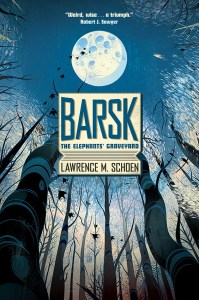
REVIEW OF BARSK, by Lawrence M. Schoen
Barsk follows a similar thread to Adams’ Watership Down or Clement-Davies’ Sight trilogy. While it is not exclusively a furry story, it deals solely with anthropomorphic animal characters, predominantly the Fant.
This story is generally science fiction, taking place long after humans are gone, and many animals have become standing, intelligent beings with their own culture, history, government, and religion. Barsk itself is the world of the Fant, the anthro-elephants of this universe. Through a drug known as koph, certain Fant are able to communicate with members of the dead with whom they were close. The two main characters, Jorl and Pizlo, find themselves trying to survive amid the many intergalactic forces who are trying to mine Barsk for the secret of koph. While Barsk had once been completely safe from outside forces due to their constant exportation of the drug, with many parties now desperate to understand the drug and possibly manufacture some of their own, Barsk and its inhabitants are no longer safe.
The plot is certainly emotional as we see Jorl speak with dead family and friends frequently throughout the narrative. However, what this book excels with is its incredible imagery and world-building. We are immediately immersed—but not lost—in new languages, mythologies, politics, and social structures. While, again, this level of culture is typically seen in Watership Down and The Sight, it was a pleasant surprise to see this applied more to science fiction, as opposed to fantasy. I hear some fans in the background calling, “What about Star Wars?” A valid point, but, at least with the mainstream canon, that universe is typically devoid of the rich mythos and deep immersion prevalent in Barsk. It is refreshing to see an anthro-animal sci fi novel that makes the characters the perfect blend of human and animal: they are completely relatable while still being highly animalistic. That is, we can connect with the characters without ever thinking they are not animals.
With the plot’s emotional developments and high level of action, one would expect an intense ending. However, that is just not the case here. As is my frequent critique of anthro-animal literature, the ending seems incredibly rushed, with the author struggling to tie all the loose ends in twenty pages or less. I won’t include spoilers this time, but the ending comes off as too mechanical, losing much of the mystic quality that pervades 90% of the plot.
A further issue I take with this novel is the downplaying of the secondary characters. Many of the secondary characters become mere caricatures or cookie-cutters, rather than actually deep individuals. With such a rich world at the author’s disposal, I would have expected a more serious consideration of characters besides the two primary protagonists.
Even with the critiques regarding the ending and secondary characters aside, this is definitely a book that I would recommend to any furry reader or fan of Richard Adams or David Clement-Davies. The world-creation in play with this novel is on point at best, and it would be a real treasure to see Schoen not only continue to delve into the world of the Fants but also into more of the other worlds of this universe. A stellar read!
 Furry Times