Differing Opinion: The Goat Review by Hypetaph

A friend of Thurston Howl, by the name of Hypetaph wrote his own review of The Goat. I hope you enjoy it was much as Thurston Howl’s

Minor spoilers ahead:

A stereotypical man’s man, the protagonist mechanic Frank of Kieffer’s “The Goat: Building a Perfect Victim” finds himself in yet another bout with his wife, this time with the expectation that their separation will last for good. Both relieved and mildly uncertain in his feelings, he finds himself reunited with an old classmate from high school—one he used to bully on the regular: Glenn. Through a series of violence and submission, Frank and Glenn begin a budding pseudo-relationship (“pseudo-” in the sense that Frank swears up-and-down that he is not gay), but this relationship becomes much more than Frank could have possibly anticipated.

“The Goat” takes place in a setting in which casual magic is a regular part of life: Glenn uses technomancy for his work with computers; Frank uses wards to protect his cars from rust; et cetera. That being said, it is revealed that Glenn does not feel as though he is truly himself in his body. Rather, he is actually a goat, just trapped in the wrong form—termed “species-dysmorphic” in the novel. This opens brand new windows for Frank, as the transformation requires a high threshold of pain Glenn must endure; thresholds Frank is more than willing to explore. It is through these explorations their relationship begins to wriggle its way under the reader’s skin.

Being written a first-person limited narrative style, Frank is quite well-developed as the narcissistic, violent, stubborn man that he is. Consequently, Glenn is not permitted much development, and when he is it feels more as a means to flesh Frank than to develop Glenn. While this self-centered means of focus is true to Frank’s character, it makes it hard for a reader to sympathize with Glenn, whose problems are arguably more of a focus in the novel. If when reading your curiosity is of Frank, you will not be left wanting. However, there are numerous questions about Glenn that go unanswered—reasonably so, though unsatisfactorily.

When it comes to diction, Kieffer’s portrayal of pain, fear, and generally horrific imagery is incredible. You will find yourself having to reread paragraphs in bewilderment, wondering, “Did I read that correctly?” This feeling is exactly what scenes of horror should do, and Kieffer excels at it.

However, such immersion is lacking in the regular scenes of eroticism within the novel. Not for a lack of what is happening, for Kieffer is more than willing to display the aggressive side of Frank during the numerous sexual encounters within the novel. Instead, the language he chooses to utilize sometimes detracts from the combined senses of seriousness, eroticism, and fear. One example, quoted directly, being: “When I realized that he was halfway to la-la land, I slapped him around a bit.” Small descriptors like this somewhat remove the reader from full engagement. Maybe it is just me, but I have difficulty believing that “la-la land” would be in the thought processes of a grown mechanic beating his sadomasochistic lover in the shower.

As I read, I argued to myself that such writing was perhaps a mimic of the mechanic’s speech, but then I had a similarly difficult time justifying particularly eloquent word choices used to describe other, non-sexual scenes. Such simplifications of emotion in otherwise meant-to-be-violent scenarios give the feeling that Kieffer was not comfortable writing it. This was unfortunate, as with horror one similarly wants the reader to be uncomfortable reading it.

Despite these critiques, the story flows and successfully remains more disturbing than not. The magic system is introduced somewhat clumsily, but remains consistent as a casual and available source of information throughout the novel, reiterating the normalcy of its practice.

As for the ending… it was not anything I had expected. I literally found myself whispering “Oh my God” as I read because the transpiring of events caught me so off-guard and were so surprising yet not out-of-character that I simply was not sure how I felt beyond shocked. Even as I write this review I am still unsure of my feelings because it came as so staggeringly unbelievable yet still so very plausible that I cannot believe I had not imagined the possibility before.

If what one is looking for is a quick, unusual horror with a twist ending, “The Goat” is the book to fit that criterion. It ends leaving the reader with the right kind of ambiguities: the “why?” questions, not the “how?” Questions are answered, but it is the mark of good horror to make the reader not want to believe them, and “The Goat” succeeds in this endeavor.

The Goat Review by Thurston Howl

c6aeca87c3e1935bf04db21bf29201685f9ac733-thumb

REVIEW OF THE GOAT: BUILDING A PERFECT VICTIM BY BILL KIEFFER

Shock. From beginning to end. If you ever want a book to slap you in the face as hard as
possible, this…this is for you.

Frank is a car worker. He is not gay. To verify this, he would not hesitate to glare you down. He would not hesitate to hit you. He would not hesitate to force you into his car. He would not hesitate to force your head on his cock and eventually force you to swallow. This is how he started to develop a relationship with Glenn.

Glenn is a cybermancer, strong with technological pseudomagic but not so great at wards like Frank. Loving the utter dominance Frank forces onto him, Glenn enters into an S&M relationship with the mechanic. However, the main story arc occurs when Glenn reveals that he is speciesdysmorphic: despite being born in a human body, his natural identity is that of a goat. Unable to pass the necessary animage tests, he can only dream about becoming a goat. However, Frank is a little better with magic…

This book is by NO MEANS a kinky romance. This is, as the author claims, horror erotica. Even as a Stephen King and Clive Barker fan, I was cringing so hard from the beginning and ending of the book, and I’m not sure I will fully recover in the next week. I might have to read My Little Pony fanfiction to survive in fact.

As far as constructive criticism goes, the book excels with its ability to horrify and disturb readers. As any horror aficionado will claim, the best horror is the kind that dwells under the surface of normal, everyday life and then bubbles up with an exploding pop at points. This novel thrives on that. You will fall in love with these characters, and, then, you will witness the new master of furry horror as he proceeds to not only rip your heart out, but also your intestines, your spleen, and whatever else he can find. While this book is by no means gory as my metaphor would make it seem, it is horrifying in levels that portray crueler fates than disembowelment. My main critiques are with the magic system erected in the novel. It is introduced so suddenly and never really explained, although it is expanded gradually. Narratologically, the magic exists solely as a means of giving Frank the ability to control Glenn’s transformations. While the author does implement small uses of magic here and there—wards and a magical advisory board—it seems consistently too disconnected from the story Kieffer is trying to tell.

However, if you can suspend your disbelief in this system of magic, the novel will grip you—and drag you through the hell that is Frank’s twisted mind, or to put it more closely to the author’s words, Frank’s “fucked up” mind.

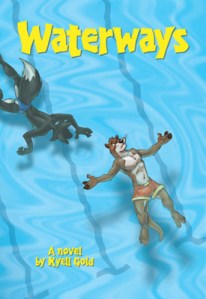
Review of Waterways by Thurston Howl

ww_cover

REVIEW OF WATERWAYS, by Kyell Gold

Gold started this book as the novella / short story entitled “Aquifers.” It gradually became the full novel Waterways, and, though one of his Kyell’s older works (2008), it remains one of his most powerful.

The synopsis is simple enough. Christian-raised otter Kory unintentionally starts falling for the openly gay fox Samaki. Initially, it seems innocent enough. They just like talking about science fiction, and, then, they start holding hands…and kissing…and it only escalates from there. Kory struggles on multiple layers: meeting his own expectations, meeting Samaki’s, meeting his mother’s, and meeting God’s.

While Kory deals with what it is to be gay, he also struggles to apply for college and work at the local LGBT homeless youth shelter, where he meets the incredibly nihilistic bat Malaya and fosters his relationship with Samaki. The subplots primarily introduced through parts two and three of the story are part of the novel’s strong points. Just with his Dev and Lee series, Gold excels in his use of strong secondary characters. If I was stopped and asked who my favorite character in Waterways was, I would have to go through the entire list. Sure, it would start with Kory and Samaki, but then, it would move to the rebellious but gentle-hearted Nick, the eye-rolling Malaya, the almost-sympathetic Sal, and Kory’s own “Bible-thumping” mother.

Now, let me say that when I started this book, I was hesitant. My own religious views made me wary of the possible claims Gold could make. I was pleased to find a completely tasteful treatment of religion in which there are positive role models in the Church, just as there are characters who negatively use scripture. It was by no means a one-sided or one-dimensional polemic on Gold’s part. Very tasteful regardless of your religious views.

SPOILER ALERT: My only, single critique of the book was the pacing toward the end. At least three plot points are resolved at the end. 1. Kory’s relationship with Samaki: The whole book, Kory struggles with even admitting to himself that he’s gay. He is too nervous to even attend the prom with Samaki despite having promised. Then, at his graduation, he decides to make Samaki join him in his graduation photo despite his mother’s protests. The next we see of them, they are at the new college, both completely open. Pacing-wise, I think the epilogue could have been expanded quite a bit. To readers, Kory’s very identity is connected with his nervousness and maybe even shame. It would have been nice to see more of what happened that summer, or, alternatively, the story could have ended right at graduation. 2. New college: Kory and Samaki clearly have decided to go to college together. Kudos to them! However, college is such a new environment, and, throughout the novel, Kory is very aware of new surroundings. However, when he starts college, he seems oblivious to the fact that this is new for him. He acts like he’s been there all his life. While one might argue that this is because he has just changed so much, it is still a hard transition: we have watched Kory struggle for over two years with Samaki. Our camera goes off him for two and a half months, and he is suddenly a completely new character. 3. Kory’s relationship with his mother: At the end of the third part, Kory fights back against his mother, but not in a way that actually attacks her. He is diplomatic and demonstrates clear maturity at this point. However, in the epilogue, Kory comments that perhaps he is on the way to forgiveness, and that he pities her. That’s all we get. It may sound like I would expect us to have a perfect happy ending with the mother, but that’s not it at all. I think it would be better if we just had more insight into her as a character. Despite her importance to the plot, she becomes one of the least flushed-out secondary characters in the novel. Perhaps, we enter her head more fully with Lee’s mom in the final books of the Dev and Lee series.

SPOILERS CONCLUDED: I know it may sound incredibly petty to criticize what is really just a three-page epilogue. When I was in the marching band, my director once told me about the judges in the press box: “When the show’s finished, they’ll remember two things: how we start and how we finish.” The epilogue of Waterways seemed rushed at best and incredibly simplistic at worst.

Overall, however, Waterways is one of my favorite of Gold’s books and brought me close to tears at numerous places. I have found the book I will recommend to religious people who deal with LGBT issues, whether they are parents of LGBT teens, or the LGBT teens themselves.

Review of Heat Volume 12 by Thurston Howl

Heat12_FrontCover-lg

By Jonny Thurston edited by Dark End

The twelfth volume of Heat came out in 2015. This series is known for its straight and gay erotic stories and comics. This volume, like many before, featured a wealth of high quality works. As this is an anthology, however, this review shall try to present each work uniquely before discussing the editing for the overall collection. I will try to avoid spoilers when possible.

“Bears, Repeating,” by Tony Grefox is the opening story for the collection, and it is a great introduction to a great anthology. The young red panda Owen gets a temp job as a server for a class reunion party. However, he gets more than expected when a wealthy bear decides to become Owen’s “sugar daddy.” While the premise is far from original for gay erotica, the real twist comes when the bear’s wife gets involved, making this story a fun standard for gay and bi furs.

“Creation Myths” by Kyell Gold and Kamui is a comic elaborating on possible interpretations of a creation myth. The black-and-white, yet playful, style of the artist well compliments Gold’s own fox-like, trickster style of storytelling. While the art becomes increasingly erotic through the comic, what excels is the artist’s and author’s ability to combine sexuality with divinity in a very pragmatic way, without being irreverent. There is much to be gained from this comic in terms of epic quality.

“A Private Escape” by Kandrel has generated mixed thoughts personally. It focuses on the hard-boiled crime writer Arthur and his imaginary conversations with his private investigator protagonist Dirk. Gradually, Arthur and Dirk realize that Arthur has written himself into the novels and has his own sexual fantasies of Dirk. The story switches between the crime story Arthur is writing and Arthur’s imaginary conversations. Just as Dirk critiques, a lot of Arthur’s writings are cliche and uninteresting. However, the meta-writing scenes are provocative and captivating. My greatest critique is definitely that the crime fiction accounts could have been shortened if not cut. Otherwise, a certainly unique story.

“Meena Mae” is a poem written by Huskyteer. While the accompanying illustration by Jess Beckly is evocative and enticing, the poem seemed much less serious. When one examines the top erotic poetry of Western culture, from Ovid to Shakespeare to Rumi to the scores of poets the past twenty years, there is a general acknowledgment that a sing-songy tone does not make for a turned-on reader. While one could argue the poem comes off as “playful,” it is not really a sexual playful as the poet likely intended it to be.

“The Games We Play” is a story by the collection’s editor, Dark End. Definitely one of the more unique stories in the collection, it focuses on some paper-based role-playing gamers. The four characters are faced with a fox succubus in the game and start exploring their characters’ sexualities just as one of the real game players explores his own sexual openness among his friends. The strength of this story is a clear and attention-grabbing plot with well-designed characters. Its greatest setback, a compliment to the author himself perhaps, is that it was too short. I would like to see more of these characters and hope Dark End pursues them.

“TIC” by Rechan is easily the worst story in the collection. It follows Henry, a male fox crippled by ALS, and his wife Margaret. As we learn that Henry only has a few months left to live and can use less and less of his muscles, Margaret tries to find ways to still sexually please her husband before he dies. I have personally never read a more emotionally bipolar story. Readers are torn between being vaguely turned on and feeling sorry for the couple. When discussing matters of life and death, sexual pleasure, for most people, is usually lower on the list of priorities. Even Henry is uninterested for most of the story. I definitely think this is the odd one out of the collection.

“Pizza Repair” by 333456 is a furry lesbian comic. Through a pizza delivery roleplay, two girlfriends have a night of fun. The writing and art are simple yet erotic. The dialogue stays light, playful, and teasing. Even without the complexity of some of the other stories, this comic excels with its purpose.

“Cosmoknots” by Tempe O’Kun and illustrated by PegiBruno is a fun and erotic poem featuring a straight couple having sex in space while being televised. The language and style for this poem are incredibly appropriate, providing both the speculative wonder of science fiction, and the thrill of public exposure. The playfulness of the lines complements the content well without being sing-songy. The wolfish, cartoony art serves as a great backdrop for the poem as it portrays the spectacle with celestial wonder and humor. An excellent read.

“Glory of the Gods” by NightEyes DaySpring tells the tale of the fennic Sanis and the jackal Askan. While Askan fails at becoming accepted by the goddess Diana, Sanis is thriving as a follower of Bacchus. When Sanis attempts to conduct a blood ritual in surrender at Askan’s ignoring him, Askan realizes he needs to re-evaluate his priorities and have the sex of his lifetime to at least join Sanis. This story manages to be incredibly erotic while being entirely provocative and emotional. Everything a critic could ask for in an erotic story, NightEyes provides with memorable characters and a voice of finesse.

“Whiteout” by Rukis takes place in a snow-covered apocalyptic settlement. The blind fox healer Puck is ready to die of starvation when a sick trapper needs healing. With food for payment, Puck tends to the trapper’s sickness. Their intimacy throughout the period grows and becomes incredibly sexual. Rukis, as usual, provides stellar art with wonderful story. Starting in media res, the story provides a very natural plot arc with completely unforgettable characters and an intimacy most readers will envy.

The final story is “Unfading” by Slip-Wolf. First, I want to say that we need more furry fiction that deals with transgender people. This story follows Amar. Amar is biologically born a wolf but identifies as a rabbit. Throughout the story, she undergoes surgery to change her form to match her identity, replacing her wolf ears for rabbit ears, her nose for a rabbit nose, etc. She struggles with her family, her lovers, and finally herself. This story is a must-read for trans furs everywhere and a welcome inclusion to this collection.

Examining the collection as a whole, HEAT has some definite strengths and weaknesses. Strengths: The formatting for the stories is superb, especially notable in “A Private Escape” when dealing with multiple narratives. The art generally complemented the writing rather than distracted from it. Also, I must commend Dark End on the ordering of the stories. One of the finer arts of being the editor of a collection is deciding the perfect order. You have to start strong and end strong but also keep at least some interest in the middle, and Dark End pulls that off splendidly. Weaknesses: I can only think of one glaring issue. There needs to have been a lot more proofreading. Especially in the first written works, typos and grammar mistakes abound. As is my usual philosophy, I do not fault the authors, but the editors. However, despite many of the critiques I have given in this review, the twelfth volume of HEAT is one of the best volumes in the series and a milestone for the LGBT community through its dealing with transgender concerns. I would highly recommend this to any sexual fur, regardless of orientation. I applaud Dark End, Teagan Gavet, Alopex, and Jeff Eddy on the intense amount of work required for such a stunning volume of furry literature.

Out of Position Review by Thurston Howl

Untitled

In my effort to bring more content to this blog, I like to introduce Thurston Howl very 1st (which I hope of many) review. I think he is an excellent writer, and really gets into the material. See if you agree.

Review of the Out of Position series by Kyell Gold
By Thurston Howl

Last month, January 2016, marked the end of the one of the most popular furry novel series at least in the past decade. Kyell Gold, frequent Ursa Major Award winner, published the first of the five book series in 2009, telling the story of football star Devlin Miski and gay rights activist Wiley Ferrel.

I will try to give as few spoilers as possible with this review, as I do not want to ruin a single volume of the series for potential readers. However, I think it is safe to discuss the basic plots of the series and the characters.

Out of Position starts with Dev the tiger hitting the bars after a game. After he lets a pretty fox take him to her bedroom, he suddenly realizes this fox is no lady. The novel follows his increasing feelings for the gay—and occasionally cross-dressing—fox Lee, while Lee struggles to stay afloat while he juggles helping Dev memorize his plays and keeping his English grades up. An old friend of Lee’s, a skunk named Brian, frequently antagonizes Dev and Lee’s relationship by trying to out Dev publicly.

The next two novels (Isolation Play and Divisions) focus primarily on Dev and Lee confronting their parents. While Dev’s are morally conservative, Lee’s mother becomes devoutly religious. Both of the characters deal with very real issues in America’s present-day LGBT community, and these issues are not made light of in this series. In a very pragmatic and visceral way, Gold creates one of the most emotional allegorical novelizations of modern struggles for the gay male. Among the questions Gold addresses are the following: Do I have to say I’m gay to be gay? What do I do if my parents don’t accept me? Am I gay if I’m just the “top?” Can I believe in God and still be gay?

The final two novels (Uncovered and Over Time) deal more with Dev and Lee’s interpersonal relationship as well as their relationship with the football community. Between settling on houses and Lee’s struggle for a job, they stay emotionally, mentally, and often physically stressed to the breaking point. Not only do they come to realize how much work a relationship requires, but they also have to, for the first time, think about what comes next for them.

I came into this series as a football opponent: I saw football as a mind-draining game for blumbering buffoons. Of course, I was saying this from a comfy seat in the ivory tower, but I was confident of this idea. This series had no appeal to me whatsoever until a friend begged me to try it. I will proudly admit now that I had been incredibly wrong. This series is a must-read for everyone, regardless of their relationship to football. It has such poignant themes throughout, about relationships, love, living, and, sure, football.

Gradually, I started to feel that Lee was the literary incarnation of myself. Sure, tons of readers think that of their favorite books, but I speak the truth here. Same majors, same favorite coffee, same dislike for Starbucks, same attitude, same mentalities, and what happened with Lee’s parents happened the exact same way to me at the exact time I was reading that book (book three, if memory serves correctly). Still, I’ve known fans of the book to associate more with Dev. I’ve known others who admired Gerrard and other characters too. The point is that, in reading this series, you are bound to find yourself relating to the characters here.

[SPOILER ALERT: SKIP THIS PARAGRAPH IF YOU HAVE NOT READ THE FINAL BOOK]
I feel that I have to speak on the newest volume of the series, and I cannot fully do that without giving some spoilers, so I’ll just add a disclaimer above. Over Time brought me to tears. To this day, I have read far too many books to count (well, in my house alone, I have 800 books presently), but only three have ever made me cry: Tell the Wolves I’m Home by Carol Rifka Brunt, Fault in Our Stars by John Green (don’t judge me), and Over Time by Kyell Gold. Throughout this book, Gold dropped hints about “marriage,” usually through an examination of other married couples in the book or a focus on rings. I was deeply wanting there to be a successful proposal by the end of the book. Increasingly, the concept of marriage became more overt. Despite any chance of a surprise being ruined, I was thrilled, because then I was sure Gold would have that scene at the end. Sure enough, there was a proposal, but it didn’t go the way I had expected. I had the proposer wrong and the outcome wrong. Yet, I was still pleased. Gold didn’t give us a cliffhanger, a dropoff, or even the perfect happy ending. He gave us the middle road, the one “not taken.” I was so incredibly relieved at the way it ended, the perfect ending for a series, one that makes us sigh in relief.

[SPOILERS CONCLUDED]
I have praised this series highly and shall continue to recommend it, but I would still like to point out my criticisms. The least powerful novel of the set was definitely Isolation Play. Though it dealt with poignant issues, probably the first hundred pages were mostly unnecessary. I have two friends who tried to read the entire series but could not get through the second book. Granted, this may be more of a critique of the editor than the author. However, the point stands that much of the second book comes off as literary fluff rather than literary stuff. I was glad to see the books pick up the pace of the first book after Isolation Play. My second critique may very well be amended upon Gold’s next books in this same universe: There were so many characters who played a minor role yet teased us. Brain, for example, is a major character in the first book. From then on, he floats in and out, getting a major role in book three or four for a few chapters. I might be the only one to say I want to see if he gets better or if he stays crazy for all eternity. Some of Lee’s friends from before meeting Dev are mentioned briefly in the series only to have a reunion at the end of the series. Some of this character teasing can become annoying after a while: You never know who’s staying and who’s going.

Despite these two minor critiques however, the series is thoroughly enjoyable, and this calibre of excellence certainly proves that Kyell Gold is worthy of his multiple awards, and I look forward to continuing to see his work flourish.