Review of War of the Third Demon Part 1 Parents of a Savior by Casey Thomas Lehman

Keep in mind this is my first book review ever. So here it goes, the story begins for me roughly 6 months or so ago when Casey Lehman asked me to review his book.

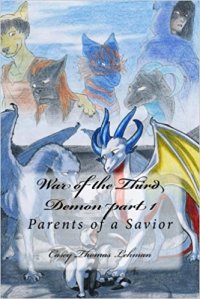
War of the Third Demon Part 1
Parents of a Savior

Frankly when I started to read this book I really didn’t know what to expect. In fact the 80 chapters took me by surprise in this 279 page book.

But despite what little problems I had when I took this on, what I discovered was really an amazing book. I wish I could write this review like others I seen going over various details of a story, like who lives and dies, what child is born to which parent. Which step children are forced into marriage as adults.

But I can’t because in all honesty it would spoil this amazing story of dragon society. Which tells of a complex society and relationships. It eerily copies human society, where in we see dragon version of friends, family and those we love, hate and ourselves. I have to give Casey Thomas Lehman my highest praise where I saw people I know and have known in this amazing society. All as she makes you feel apart of it, leaving you wanting to know more.

So what does this story cover? Everything, I have to give it too the author for keeping the story clean. But yet it doesn’t spoil the story. In fact what it doesn’t say, leaves to your own imagination of what events had taken place in between the various stories contained in this book. Which I think only makes it better in my opinion, as you will feel more apart of their world. Leaving the reader all the while wondering what will happen to these characters are time marches on…

In fact I am looking forward to the next book. Not to see if there is a war, but to see what changes will over time affect the lives of these dragons.
You can order the book from Amazon here

Circles volume 1 review

circles-volume-one-paperback-it-seems-like-ive-been-here-before-24964

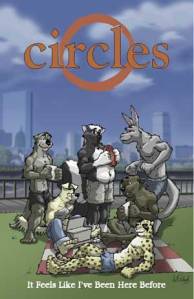
Circles volume 1 It Seems Like I’ve Been Here Before – Collects Issues 1, 2, 3, and 4 by Andrew French, Scott Fabianek, Steve Domanski. As well as issue 0 which was given away free at the time with a catalog of other furry publications.

Circles comic, which had a total of 13 issues published between 2001 and 2015. Is a straightforward look at life from the view of 4 gay men who share a home at 6 Kensey Circle. Their life, their loves, basically them finding out who they are. In the beginning one of them Paulie has to deal with the fact he is HIV+. When a skunk named Marty moves in and later on he has to admits to his family he is gay, being Jewish only complicates things. So a lot those times are included, like when one of it’s creators lost a good friend to an auto accident, that was when Paulie was killed off the same way. Meanwhile one of the characters blames himself for the accident, as it was him who got Paulie go out that night when it happened.

The Halloween party later only shows what a straight guy like me only hears about from his gay friends. How some gays treat others, sometimes it’s not very nice. Circles looks it, honestly and gives the reader, gay or straight to see how the characters deal with such matters. The last comic included really touches my heart. Dealing with loss, family, lack of kids at your feet and the holidays.

Circles is well worth a read, and you don’t have to be gay to read it. In fact I think straight people need to read this even more, and see what their gay friends go through, which isn’t always easy.

I found the extras included in the book a pure delight. Side stories I never even knew about, behind the scenes, you name it, it’s there. The book is for a true fan, because you get a deeper insight to these characters lives, than a simple download will never show you.

a solid 10 out of 10

Buy it here

Review of Roar Vol. 1 by Thurston Howl

image

“A Close Port of Call” by Altivo Overo is a high sci fi story centered on zebra dockmaster Mark Partine who is sent on a diplomatic mission with the charismatic lion captain Teftawn. Most of the story has Mark being nervous around Teftawn due to the species difference of predator-prey. However, the captain is sexually interested in the zebra. Amid struggles in the mission, Mark fights with his insecurities around the captain. Aside from a good writing style, the plot and characters were over-simplified and too predictable. The story is consistently homoerotic, yet the captain’s final pursuit of the zebra is written as if it should be a surprise. The sci fi universe portrayed in the story is also not very well fleshed out. Immediately after reading it, I realize I had no idea what most of the settings looked like. From an editing perspective, I would have liked to have seen a stronger opening story to the collection.

Fugue’s story “A Clockwork Mind” is a steampunk piece that inspired the cover art for the collection. A fox professor of Clockwork engineering learns that his father is dying and encounters an interesting character on the train to meet his father: a jackal sailor who is also an abolitionist and the son of a famous slave trader. Despite the unnecessary intro, this story is one of the better ones in the anthology. It had a clear sense of pacing, keeping the reader engaged and integrated the world-building efficiently throughout. I immediately felt like I was a citizen of Fugure’s clockwork world, and the in-depth characters were delightfully intriguing. Furthermore, it would be a great conversation starter for anyone interested in A.I. philosophy.

“A Song for Pandora” is a speculative fiction piece by Kevin Frane. It follows young ferret college student Cassie as she struggles with odd dreams that have her in the body of Pandora, a special ferret with the same father as Cassie. Pandora seems to be the holder of secret information that has been forgotten and forbidden in her society. For dream fiction, the story is quite cohesive and only initially disorienting. The author’s ability to set firm descriptions is a definite treat in this story. While probably one of the least furry stories in the collection, it is definitely an enjoyable read and a call to much of the great dream-based fiction we’ve seen the past fifty years.

White Yoté’s story “Dog Eat Dog” centers on the husky Killian and his solar-energy company. However, when he becomes aware the competing company has discovered the way to harvest any light energy, including moon-light and cell-light, Killian decides to enlist the help of half-cybernetic ringtail mercenary McKay to push the company to ruin. This story excels in its even pacing, making the details of the plot suspenseful and the intelligent banter attention-keeping. A very balanced, well-written piece that speaks volumes to the cannibalistic nature of greedy capitalism. As is the nature of science fiction to make bold political statements, this one fits well into the critical corpus.

The next story is another A.I. story entitled “Violet” by Stormcatcher. (SPOILERS AHEAD): Violet’s husband Mason passed away years ago. However, he left a cybernetic clone of himself behind to take care of Violet. When she activates the robot, she treats the new Mason as if they have never met: they start dating and become married. As far as the new Mason knows, Violet just doesn’t like to talk about her previous husband. When he demands to see Violet’s kids, she starts to stress out. Despite the disorienting opening in which readers do not really know this is even an A.I. story, it has rather intricate character development and plays with the A.I. trope effectively. The perspective was more than a little frustrating as it cycled a third person limited from the new Mason to a Violet (without revealing the A.I. part still) and back to some kind of third person omniscient. Enjoyable all the same. (SPOILERS CONCLUDED)

“Hyperstream” by Karai Crocuta is about jaguar Cassius and his desperate attempts to save his technologically savvy brother James from imprisonment. Cassius is imprisoned by the alien Sol, but Sol wants to make a deal with Cassius so that everyone gets what they want. The narrative of this story is incredibly hard to follow. It goes back and forth between what Cassius is really feeling and what could be a hyperstream simulation….or it could be the real hyperstream events…or it could be thoughts Sol is implanting into Cassius. None of that is really clear. What can be made of the plot is incredibly grabbing, and the characters are captivating as well. As an editor, I feel the story would have done much better had it been entirely linear, and the perspective changes make it frustrating as well. A pleasurable read for space action lovers.

“The Journal: Beginning” by Angelwolf follows Dr. Matthews in a scientific project that quickly becomes taken over by a military project. From what I gather, this story is meant to be the first chapter—or at least some excerpt—of a larger book. To be blunt and possibly an ass, I found this story to simply not belong in this collection whatsoever. It read like a Hollywood blockbuster short. Lots of action, confusion, melodrama, and explosions. The only “furry” element was a canid “creature” that appears in the last couple of pages. The author’s name was the most furry thing about the story, and the short clip did nothing to make me want to keep reading.

One of the shorter stories in the collection, “Graveyard Shift” by Redline focuses on the supernatural bounty hunter named Charade. When a mandrake starts terrorizing a town for killing its parents, Charade the fox is the only one who can save the humans. Honestly, in furry fiction, I have only seen a more badass fox once, and that was from Teiran. Charade is an amazing character and a great mix of the trickster mythos inherent with the fox and the gunslinger archetype. Although the story was not particularly gripping, the incredibly rich characterization made this story a real treasure.

“Relativity” by Rincewind tells the story of Pilot Rajit in his space exploration. The main premise is simply that he finds what he believes to be signs of alien life. Despite the cliched plot, the character kept me interested, and I wanted to keep reading. The greatest downside to this story is definitely the style. There are so many sentences throughout that are very distracting. From “in dee! pspace” to “lit up like a Christmas tree” being used to describe buttons in the middle of a panic sequence, the language is awkward and garbled on every page. Definitely needed more editing and a stronger conclusion.

One of my personal favorites from the collection is Calcifer Rauth’s piece “Kerner’s Bad Day.” Centering on enforcer-dragon Relaeth and his attached-scientist Kerner, the story starts beautifully: “Fragile glass and hard surfaces were never meant to be best friends; especially when the former was rushing to meet the latter at high velocity” (207). When Relaeth is temporarily assigned a new scientist and a murder occurs right after, Relaeth must use all of his wits and technological prowess to fight against the powers that threaten him.

Alexander Wood’s “Warm Exodus” cannot get enough praises from me. This is a tale of two wolf brothers, Enhart, the omega, and Asmodan, practically an alpha. When Enhart is suddenly the vessel for 400 alien life forms in his mind, he learns he has a time limit to get the aliens to “the Medium” before his body is ruined from the aliens’ inhabiting them. This story, although the longest one in the collection, is incredibly emotional, and it paints vivid characters, a gripping plot, and a poetic voice that has you begging the author to continue even after the story is done. A must-read for any anthro wolf fiction lover.

“The Firelight (A Parable)” is the editor’s own story in the collection. It is hard to say too much about it without giving the full synopsis. It reads very much like a furry fable, preaching a certain moral through clear, evocative language. My only real critique is that the lack of specifics (including names) makes it a lot harder to place oneself into the story.

Roar, vol.1 was quite an enjoyable read. It was pleasant to see the varying shades of furry science fiction. From an editing standpoint, much was lacking in this collection. From the apparent lack of proofreading and non-standardized English, it does not appear that the editor spent too much time with each individual story or with reading thoroughly through a proof copy. My largest critique of the book was the vast range of quality in the works. The editor seemed to accept works that lacked almost any merit whatsoever to the top tier of furry fiction. As I read through the later volumes of the series, I hope that the story selection process becomes much more critical and incisive. All the same, this is a book I would recommend any lover of furry fiction, probably just with a disclaimer.

Differing Opinion: The Goat Review by Hypetaph

A friend of Thurston Howl, by the name of Hypetaph wrote his own review of The Goat. I hope you enjoy it was much as Thurston Howl’s

Minor spoilers ahead:

A stereotypical man’s man, the protagonist mechanic Frank of Kieffer’s “The Goat: Building a Perfect Victim” finds himself in yet another bout with his wife, this time with the expectation that their separation will last for good. Both relieved and mildly uncertain in his feelings, he finds himself reunited with an old classmate from high school—one he used to bully on the regular: Glenn. Through a series of violence and submission, Frank and Glenn begin a budding pseudo-relationship (“pseudo-” in the sense that Frank swears up-and-down that he is not gay), but this relationship becomes much more than Frank could have possibly anticipated.

“The Goat” takes place in a setting in which casual magic is a regular part of life: Glenn uses technomancy for his work with computers; Frank uses wards to protect his cars from rust; et cetera. That being said, it is revealed that Glenn does not feel as though he is truly himself in his body. Rather, he is actually a goat, just trapped in the wrong form—termed “species-dysmorphic” in the novel. This opens brand new windows for Frank, as the transformation requires a high threshold of pain Glenn must endure; thresholds Frank is more than willing to explore. It is through these explorations their relationship begins to wriggle its way under the reader’s skin.

Being written a first-person limited narrative style, Frank is quite well-developed as the narcissistic, violent, stubborn man that he is. Consequently, Glenn is not permitted much development, and when he is it feels more as a means to flesh Frank than to develop Glenn. While this self-centered means of focus is true to Frank’s character, it makes it hard for a reader to sympathize with Glenn, whose problems are arguably more of a focus in the novel. If when reading your curiosity is of Frank, you will not be left wanting. However, there are numerous questions about Glenn that go unanswered—reasonably so, though unsatisfactorily.

When it comes to diction, Kieffer’s portrayal of pain, fear, and generally horrific imagery is incredible. You will find yourself having to reread paragraphs in bewilderment, wondering, “Did I read that correctly?” This feeling is exactly what scenes of horror should do, and Kieffer excels at it.

However, such immersion is lacking in the regular scenes of eroticism within the novel. Not for a lack of what is happening, for Kieffer is more than willing to display the aggressive side of Frank during the numerous sexual encounters within the novel. Instead, the language he chooses to utilize sometimes detracts from the combined senses of seriousness, eroticism, and fear. One example, quoted directly, being: “When I realized that he was halfway to la-la land, I slapped him around a bit.” Small descriptors like this somewhat remove the reader from full engagement. Maybe it is just me, but I have difficulty believing that “la-la land” would be in the thought processes of a grown mechanic beating his sadomasochistic lover in the shower.

As I read, I argued to myself that such writing was perhaps a mimic of the mechanic’s speech, but then I had a similarly difficult time justifying particularly eloquent word choices used to describe other, non-sexual scenes. Such simplifications of emotion in otherwise meant-to-be-violent scenarios give the feeling that Kieffer was not comfortable writing it. This was unfortunate, as with horror one similarly wants the reader to be uncomfortable reading it.

Despite these critiques, the story flows and successfully remains more disturbing than not. The magic system is introduced somewhat clumsily, but remains consistent as a casual and available source of information throughout the novel, reiterating the normalcy of its practice.

As for the ending… it was not anything I had expected. I literally found myself whispering “Oh my God” as I read because the transpiring of events caught me so off-guard and were so surprising yet not out-of-character that I simply was not sure how I felt beyond shocked. Even as I write this review I am still unsure of my feelings because it came as so staggeringly unbelievable yet still so very plausible that I cannot believe I had not imagined the possibility before.

If what one is looking for is a quick, unusual horror with a twist ending, “The Goat” is the book to fit that criterion. It ends leaving the reader with the right kind of ambiguities: the “why?” questions, not the “how?” Questions are answered, but it is the mark of good horror to make the reader not want to believe them, and “The Goat” succeeds in this endeavor.

REVIEW OF BARSK by Thurston Howl

Barsk-4rev4

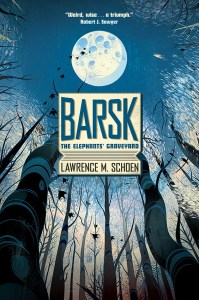
REVIEW OF BARSK, by Lawrence M. Schoen

Barsk follows a similar thread to Adams’ Watership Down or Clement-Davies’ Sight trilogy. While it is not exclusively a furry story, it deals solely with anthropomorphic animal characters, predominantly the Fant.

This story is generally science fiction, taking place long after humans are gone, and many animals have become standing, intelligent beings with their own culture, history, government, and religion. Barsk itself is the world of the Fant, the anthro-elephants of this universe. Through a drug known as koph, certain Fant are able to communicate with members of the dead with whom they were close. The two main characters, Jorl and Pizlo, find themselves trying to survive amid the many intergalactic forces who are trying to mine Barsk for the secret of koph. While Barsk had once been completely safe from outside forces due to their constant exportation of the drug, with many parties now desperate to understand the drug and possibly manufacture some of their own, Barsk and its inhabitants are no longer safe.

The plot is certainly emotional as we see Jorl speak with dead family and friends frequently throughout the narrative. However, what this book excels with is its incredible imagery and world-building. We are immediately immersed—but not lost—in new languages, mythologies, politics, and social structures. While, again, this level of culture is typically seen in Watership Down and The Sight, it was a pleasant surprise to see this applied more to science fiction, as opposed to fantasy. I hear some fans in the background calling, “What about Star Wars?” A valid point, but, at least with the mainstream canon, that universe is typically devoid of the rich mythos and deep immersion prevalent in Barsk. It is refreshing to see an anthro-animal sci fi novel that makes the characters the perfect blend of human and animal: they are completely relatable while still being highly animalistic. That is, we can connect with the characters without ever thinking they are not animals.

With the plot’s emotional developments and high level of action, one would expect an intense ending. However, that is just not the case here. As is my frequent critique of anthro-animal literature, the ending seems incredibly rushed, with the author struggling to tie all the loose ends in twenty pages or less. I won’t include spoilers this time, but the ending comes off as too mechanical, losing much of the mystic quality that pervades 90% of the plot.

A further issue I take with this novel is the downplaying of the secondary characters. Many of the secondary characters become mere caricatures or cookie-cutters, rather than actually deep individuals. With such a rich world at the author’s disposal, I would have expected a more serious consideration of characters besides the two primary protagonists.

Even with the critiques regarding the ending and secondary characters aside, this is definitely a book that I would recommend to any furry reader or fan of Richard Adams or David Clement-Davies. The world-creation in play with this novel is on point at best, and it would be a real treasure to see Schoen not only continue to delve into the world of the Fants but also into more of the other worlds of this universe. A stellar read!

Out of Position Review by Thurston Howl

Untitled

In my effort to bring more content to this blog, I like to introduce Thurston Howl very 1st (which I hope of many) review. I think he is an excellent writer, and really gets into the material. See if you agree.

Review of the Out of Position series by Kyell Gold
By Thurston Howl

Last month, January 2016, marked the end of the one of the most popular furry novel series at least in the past decade. Kyell Gold, frequent Ursa Major Award winner, published the first of the five book series in 2009, telling the story of football star Devlin Miski and gay rights activist Wiley Ferrel.

I will try to give as few spoilers as possible with this review, as I do not want to ruin a single volume of the series for potential readers. However, I think it is safe to discuss the basic plots of the series and the characters.

Out of Position starts with Dev the tiger hitting the bars after a game. After he lets a pretty fox take him to her bedroom, he suddenly realizes this fox is no lady. The novel follows his increasing feelings for the gay—and occasionally cross-dressing—fox Lee, while Lee struggles to stay afloat while he juggles helping Dev memorize his plays and keeping his English grades up. An old friend of Lee’s, a skunk named Brian, frequently antagonizes Dev and Lee’s relationship by trying to out Dev publicly.

The next two novels (Isolation Play and Divisions) focus primarily on Dev and Lee confronting their parents. While Dev’s are morally conservative, Lee’s mother becomes devoutly religious. Both of the characters deal with very real issues in America’s present-day LGBT community, and these issues are not made light of in this series. In a very pragmatic and visceral way, Gold creates one of the most emotional allegorical novelizations of modern struggles for the gay male. Among the questions Gold addresses are the following: Do I have to say I’m gay to be gay? What do I do if my parents don’t accept me? Am I gay if I’m just the “top?” Can I believe in God and still be gay?

The final two novels (Uncovered and Over Time) deal more with Dev and Lee’s interpersonal relationship as well as their relationship with the football community. Between settling on houses and Lee’s struggle for a job, they stay emotionally, mentally, and often physically stressed to the breaking point. Not only do they come to realize how much work a relationship requires, but they also have to, for the first time, think about what comes next for them.

I came into this series as a football opponent: I saw football as a mind-draining game for blumbering buffoons. Of course, I was saying this from a comfy seat in the ivory tower, but I was confident of this idea. This series had no appeal to me whatsoever until a friend begged me to try it. I will proudly admit now that I had been incredibly wrong. This series is a must-read for everyone, regardless of their relationship to football. It has such poignant themes throughout, about relationships, love, living, and, sure, football.

Gradually, I started to feel that Lee was the literary incarnation of myself. Sure, tons of readers think that of their favorite books, but I speak the truth here. Same majors, same favorite coffee, same dislike for Starbucks, same attitude, same mentalities, and what happened with Lee’s parents happened the exact same way to me at the exact time I was reading that book (book three, if memory serves correctly). Still, I’ve known fans of the book to associate more with Dev. I’ve known others who admired Gerrard and other characters too. The point is that, in reading this series, you are bound to find yourself relating to the characters here.

[SPOILER ALERT: SKIP THIS PARAGRAPH IF YOU HAVE NOT READ THE FINAL BOOK]
I feel that I have to speak on the newest volume of the series, and I cannot fully do that without giving some spoilers, so I’ll just add a disclaimer above. Over Time brought me to tears. To this day, I have read far too many books to count (well, in my house alone, I have 800 books presently), but only three have ever made me cry: Tell the Wolves I’m Home by Carol Rifka Brunt, Fault in Our Stars by John Green (don’t judge me), and Over Time by Kyell Gold. Throughout this book, Gold dropped hints about “marriage,” usually through an examination of other married couples in the book or a focus on rings. I was deeply wanting there to be a successful proposal by the end of the book. Increasingly, the concept of marriage became more overt. Despite any chance of a surprise being ruined, I was thrilled, because then I was sure Gold would have that scene at the end. Sure enough, there was a proposal, but it didn’t go the way I had expected. I had the proposer wrong and the outcome wrong. Yet, I was still pleased. Gold didn’t give us a cliffhanger, a dropoff, or even the perfect happy ending. He gave us the middle road, the one “not taken.” I was so incredibly relieved at the way it ended, the perfect ending for a series, one that makes us sigh in relief.

[SPOILERS CONCLUDED]
I have praised this series highly and shall continue to recommend it, but I would still like to point out my criticisms. The least powerful novel of the set was definitely Isolation Play. Though it dealt with poignant issues, probably the first hundred pages were mostly unnecessary. I have two friends who tried to read the entire series but could not get through the second book. Granted, this may be more of a critique of the editor than the author. However, the point stands that much of the second book comes off as literary fluff rather than literary stuff. I was glad to see the books pick up the pace of the first book after Isolation Play. My second critique may very well be amended upon Gold’s next books in this same universe: There were so many characters who played a minor role yet teased us. Brain, for example, is a major character in the first book. From then on, he floats in and out, getting a major role in book three or four for a few chapters. I might be the only one to say I want to see if he gets better or if he stays crazy for all eternity. Some of Lee’s friends from before meeting Dev are mentioned briefly in the series only to have a reunion at the end of the series. Some of this character teasing can become annoying after a while: You never know who’s staying and who’s going.

Despite these two minor critiques however, the series is thoroughly enjoyable, and this calibre of excellence certainly proves that Kyell Gold is worthy of his multiple awards, and I look forward to continuing to see his work flourish.