
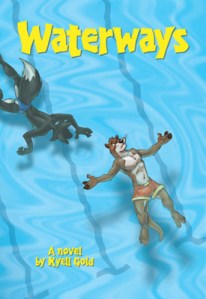
REVIEW OF WATERWAYS, by Kyell Gold
Gold started this book as the novella / short story entitled “Aquifers.” It gradually became the full novel Waterways, and, though one of his Kyell’s older works (2008), it remains one of his most powerful.
The synopsis is simple enough. Christian-raised otter Kory unintentionally starts falling for the openly gay fox Samaki. Initially, it seems innocent enough. They just like talking about science fiction, and, then, they start holding hands…and kissing…and it only escalates from there. Kory struggles on multiple layers: meeting his own expectations, meeting Samaki’s, meeting his mother’s, and meeting God’s.
While Kory deals with what it is to be gay, he also struggles to apply for college and work at the local LGBT homeless youth shelter, where he meets the incredibly nihilistic bat Malaya and fosters his relationship with Samaki. The subplots primarily introduced through parts two and three of the story are part of the novel’s strong points. Just with his Dev and Lee series, Gold excels in his use of strong secondary characters. If I was stopped and asked who my favorite character in Waterways was, I would have to go through the entire list. Sure, it would start with Kory and Samaki, but then, it would move to the rebellious but gentle-hearted Nick, the eye-rolling Malaya, the almost-sympathetic Sal, and Kory’s own “Bible-thumping” mother.
Now, let me say that when I started this book, I was hesitant. My own religious views made me wary of the possible claims Gold could make. I was pleased to find a completely tasteful treatment of religion in which there are positive role models in the Church, just as there are characters who negatively use scripture. It was by no means a one-sided or one-dimensional polemic on Gold’s part. Very tasteful regardless of your religious views.
SPOILER ALERT: My only, single critique of the book was the pacing toward the end. At least three plot points are resolved at the end. 1. Kory’s relationship with Samaki: The whole book, Kory struggles with even admitting to himself that he’s gay. He is too nervous to even attend the prom with Samaki despite having promised. Then, at his graduation, he decides to make Samaki join him in his graduation photo despite his mother’s protests. The next we see of them, they are at the new college, both completely open. Pacing-wise, I think the epilogue could have been expanded quite a bit. To readers, Kory’s very identity is connected with his nervousness and maybe even shame. It would have been nice to see more of what happened that summer, or, alternatively, the story could have ended right at graduation. 2. New college: Kory and Samaki clearly have decided to go to college together. Kudos to them! However, college is such a new environment, and, throughout the novel, Kory is very aware of new surroundings. However, when he starts college, he seems oblivious to the fact that this is new for him. He acts like he’s been there all his life. While one might argue that this is because he has just changed so much, it is still a hard transition: we have watched Kory struggle for over two years with Samaki. Our camera goes off him for two and a half months, and he is suddenly a completely new character. 3. Kory’s relationship with his mother: At the end of the third part, Kory fights back against his mother, but not in a way that actually attacks her. He is diplomatic and demonstrates clear maturity at this point. However, in the epilogue, Kory comments that perhaps he is on the way to forgiveness, and that he pities her. That’s all we get. It may sound like I would expect us to have a perfect happy ending with the mother, but that’s not it at all. I think it would be better if we just had more insight into her as a character. Despite her importance to the plot, she becomes one of the least flushed-out secondary characters in the novel. Perhaps, we enter her head more fully with Lee’s mom in the final books of the Dev and Lee series.
SPOILERS CONCLUDED: I know it may sound incredibly petty to criticize what is really just a three-page epilogue. When I was in the marching band, my director once told me about the judges in the press box: “When the show’s finished, they’ll remember two things: how we start and how we finish.” The epilogue of Waterways seemed rushed at best and incredibly simplistic at worst.
Overall, however, Waterways is one of my favorite of Gold’s books and brought me close to tears at numerous places. I have found the book I will recommend to religious people who deal with LGBT issues, whether they are parents of LGBT teens, or the LGBT teens themselves.

 Furry Times